
How to Optimize Content for Search Intent
Search engines have evolved far beyond simple keyword matching. Modern search algorithms focus heavily on understanding search intent, which refers to the goal a user wants to achieve when performing a search.
Optimizing content for search intent means creating pages that align with the user's expectations when they enter a query into Google.
Instead of focusing only on keywords, SEO professionals must analyze the purpose behind a query and design content that satisfies that need.
When content matches the user's intent, search engines are more likely to rank the page because it provides the most relevant solution.
Quick Navigation:
Author: Hassan – SEO Researcher · Updated March 2026
What Search Intent Means in SEO
Search intent refers to the reason why a user performs a search query.
When someone enters a query into Google, they usually have a specific objective.
They may want to learn information, compare products, visit a particular website, or complete a purchase.
Search engines attempt to identify this objective so they can deliver results that best satisfy the user's needs.
For example, a query such as:
what is keyword research
indicates that the user wants an explanation or educational content.
However, a query such as:
best keyword research tools
suggests that the user is comparing software options.
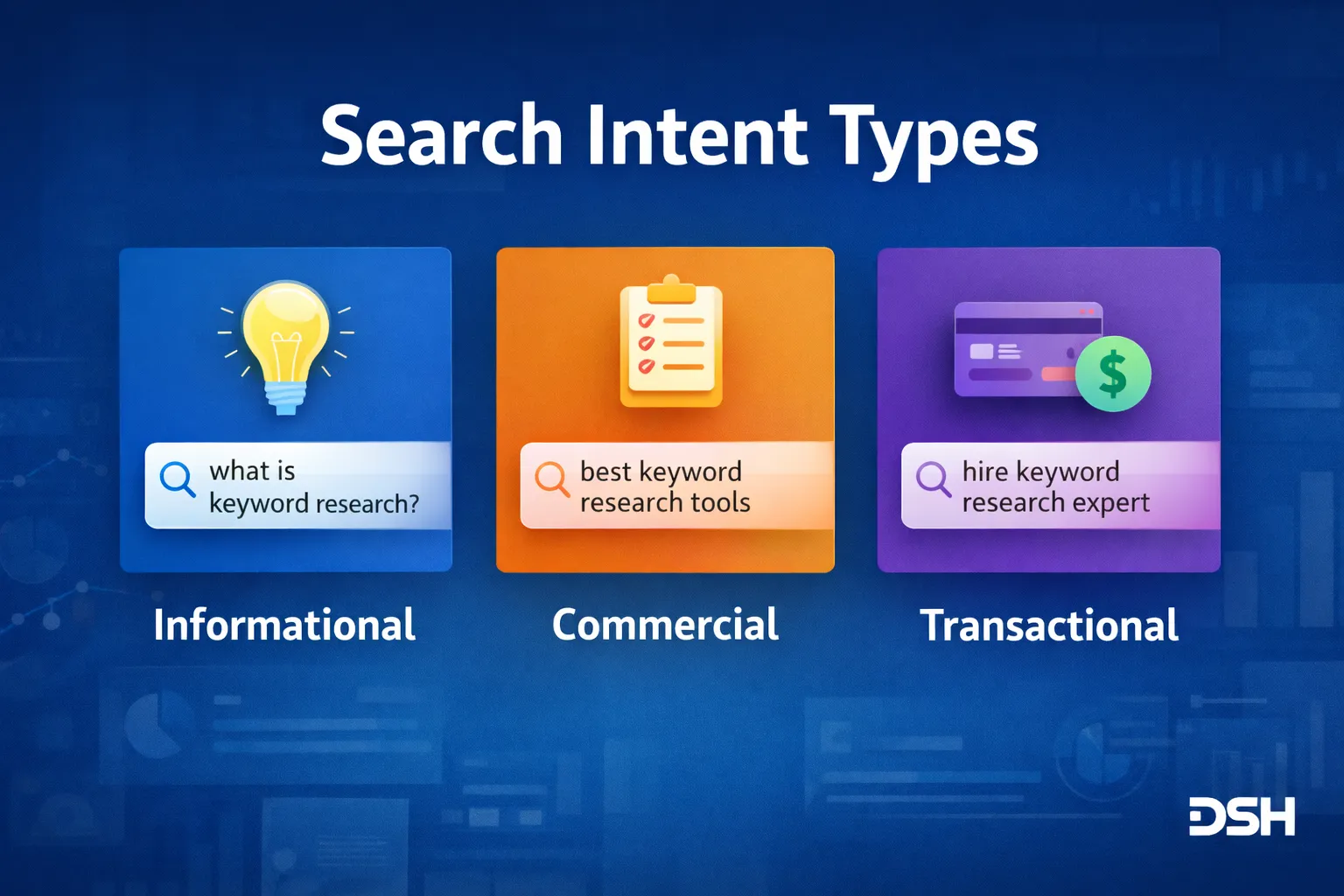
Understanding this difference is essential when optimizing content.
If content does not match the user's intent, it will struggle to rank even if it contains the correct keywords.
Why Search Intent Matters for SEO Rankings
Search intent has become one of the most important ranking factors in modern SEO.
Google’s algorithms attempt to deliver results that satisfy the user’s goal as quickly as possible.
If a page does not align with the dominant intent for a keyword, it may struggle to appear in the top search results.
For example, if a keyword mostly displays product pages in search results, publishing a long informational article may not match what users expect.
Matching search intent improves several key ranking signals.
- Click-through rate
- User engagement
- Dwell time
- Reduced bounce rate
These signals indicate to search engines that users find the content valuable.
Resources such as Google Search documentation emphasize the importance of creating helpful content that satisfies user needs.

Because of this, optimizing content for search intent significantly increases the likelihood of ranking well in search engines.
The Four Types of Search Intent
Most search queries fall into one of four primary intent categories.
Understanding these categories helps SEO professionals design content that satisfies the user's expectations.
Informational Intent
Users want to learn something or find answers to questions.
Examples include:
- what is SEO
- how to optimize content
- keyword research guide
Navigational Intent
Users are searching for a specific website or brand.
Commercial Intent
Users are researching products or services before making a decision.
Transactional Intent
Users are ready to complete an action such as buying a product or signing up for a service.

You can explore these categories further in our guide on Informational vs Navigational Keywords in SEO.
Analyzing SERPs to Identify Search Intent
One of the most reliable ways to determine search intent is by analyzing Google’s search results.
Search engine results pages reveal what type of content Google believes best satisfies the query.
SEO professionals often study the top ranking results to identify patterns.
Key questions to ask include:
- What type of pages are ranking?
- Are the results mostly blog articles or product pages?
- Do the titles contain words such as “best”, “guide”, or “review”?
- Are there featured snippets or video results?

Analyzing these patterns helps determine what type of content should be created.
You can learn more about SERP intent analysis in our guide on How to Identify Search Intent in Google SERPs.
Aligning Content With Search Intent
Once search intent has been identified, the next step is aligning the content with that intent.
Content alignment means designing the structure, format, and depth of the article to match what users expect when searching for a keyword.
For example:
- Informational queries require educational guides
- Commercial queries require comparisons or reviews
- Transactional queries require landing pages
When content format matches the dominant search intent, search engines are more likely to consider the page relevant.

In the next section of this guide, we will explore advanced strategies for optimizing content structure, keyword usage, and internal linking to match search intent.
Choosing the Right Content Format for Search Intent
After identifying the search intent behind a keyword, the next step is selecting the correct content format.
Search engines often prefer specific types of content depending on the purpose behind the query.
If your content format does not match what users expect, ranking becomes much more difficult.
For example, informational queries typically favor detailed blog articles, guides, and tutorials.
Commercial queries often show comparison pages or product reviews.
Transactional queries frequently display product pages or service landing pages.
Matching the correct content format ensures that the page aligns with user expectations.

By studying the format of pages currently ranking in Google search results, SEO professionals can determine which type of content is most likely to succeed.
Analyzing SERP Patterns to Understand Intent
Google search results provide valuable clues about how content should be optimized for a particular keyword.
SEO professionals often examine the first page of results to identify patterns among top-ranking pages.
These patterns help reveal the dominant search intent.
For example, if the first page is dominated by tutorials and educational guides, the keyword likely has informational intent.
If the results include comparison articles and product reviews, the intent may be commercial.
Studying these patterns allows SEO specialists to reverse engineer what Google expects for a query.

This method is one of the most reliable ways to determine how content should be optimized for search intent.
Using Page Titles to Identify Search Intent
Another effective method for understanding search intent is analyzing the titles of top-ranking pages.
Titles often contain keywords and phrases that reveal the purpose of the content.
Certain words frequently appear depending on the intent category.
Informational Title Signals
- How to
- Guide
- What is
- Tutorial
Commercial Title Signals
- Best
- Top
- Comparison
- Reviews
Transactional Title Signals
- Buy
- Pricing
- Order
- Plans

Recognizing these patterns can help SEO professionals quickly determine the dominant intent for a keyword.
Using SERP Features to Identify Search Intent
Google search results include several special elements known as SERP features.
These features often provide strong signals about the type of content users expect.
Common SERP features include:
- Featured snippets
- People Also Ask boxes
- Image packs
- Video results
- Product carousels
For example, if a search result contains a featured snippet answering a question, it usually indicates informational intent.
If video results dominate the page, users may prefer visual explanations.
Product carousels often suggest commercial or transactional intent.

Understanding these signals helps SEO professionals optimize content in a way that aligns with Google’s expectations.
Designing Content Structure Around Search Intent
Content structure plays an important role in satisfying search intent.
Well-organized pages make it easier for both users and search engines to understand the content.
For informational queries, content should be structured as a comprehensive guide.
This often includes clear headings, step-by-step explanations, and supporting examples.
Commercial content may include product comparisons, feature lists, and detailed reviews.
Transactional content usually focuses on conversion elements such as pricing tables, product descriptions, and call-to-action buttons.

A strong content structure ensures that users can quickly find the information they are looking for.
Mapping Keywords to Search Intent
Keyword mapping is another important part of optimizing content for search intent.
Instead of targeting random keywords, SEO professionals assign keywords to specific pages based on the user’s goal.
For example, informational keywords may target educational articles.
Commercial keywords may target comparison pages.
Transactional keywords often target product or service pages.
This strategy ensures that each page on a website serves a clear purpose.

You can explore keyword intent mapping further in our guide on Commercial vs Transactional Keywords Explained.
In the next section of this guide, we will explore how keyword clustering and semantic SEO help optimize content for search intent.
Using Keyword Clusters to Optimize for Search Intent
Modern SEO strategies rarely focus on a single keyword. Instead, they target groups of related search queries that share the same search intent.
This technique is known as keyword clustering.
Keyword clustering groups multiple related queries into a single topic that can be addressed within one piece of content.
For example, a page about optimizing content for search intent may target queries such as:
- how to optimize content for search intent
- search intent optimization strategy
- content optimization for SEO intent
- how to match search intent
Although the wording differs slightly, the user’s goal remains the same.
Instead of creating separate articles for each query, a comprehensive guide can target the entire cluster.

This approach allows a single article to rank for dozens of related search queries.
You can explore keyword clustering strategies in more detail in our guide on Keyword Clustering Framework.
Semantic SEO and Search Intent Optimization
Search engines increasingly rely on semantic search technology to understand relationships between topics.
Instead of analyzing isolated keywords, Google evaluates how concepts relate to one another within a piece of content.
Semantic SEO therefore focuses on covering a topic comprehensively rather than repeating a specific keyword multiple times.
For example, an article about search intent optimization may naturally include related concepts such as:
- keyword research
- SERP analysis
- user behavior signals
- content strategy
Including these related topics helps search engines better understand the context of the content.

Semantic optimization aligns closely with Google’s NLP technologies, which analyze language patterns to interpret meaning.
Building Topical Authority Around Search Intent
Topical authority is another important factor in search intent optimization.
Websites that publish multiple articles covering related topics are often seen as more authoritative.
For example, a website focusing on SEO might publish articles such as:
- How to Optimize Content for Search Intent
- How to Identify Search Intent in Google SERPs
- Informational vs Navigational Keywords
- Commercial vs Transactional Keywords
Together, these articles form a topic cluster that signals expertise to search engines.

Over time, this structured content ecosystem improves the website’s ability to rank for competitive keywords.
Writing NLP-Friendly Content for Search Engines
Because Google uses natural language processing to interpret content, writing clearly and naturally is essential.
Instead of focusing only on keyword density, SEO professionals now prioritize readability and clarity.
Effective NLP-friendly content usually includes:
- Clear headings and structured sections
- Natural language explanations
- Examples and definitions
- Related terms and synonyms
This structure helps search engines understand the meaning of the content more accurately.

It also improves the experience for readers by making the content easier to follow.
Internal Linking for Search Intent Optimization
Internal linking helps search engines understand how different pages relate to each other.
By linking related articles together, websites create semantic relationships between topics.
For example, readers interested in search intent optimization may also benefit from guides such as:
- How to Identify Search Intent in Google SERPs
- Informational vs Navigational Keywords in SEO
- Commercial vs Transactional Keywords Explained
- How Google Understands Search Intent
These internal links help search engines understand the relationships between pages and improve crawlability.

In the final section of this guide, we will explore advanced strategies for designing a complete search intent content strategy.
Building an Intent-Driven SEO Content Strategy
Optimizing content for search intent is not only about improving individual articles. It also involves designing an entire SEO strategy around user needs.
Websites that perform well in search engines usually structure their content to address different types of search intent across multiple pages.
Instead of publishing random blog posts, successful SEO strategies focus on solving specific user problems at each stage of the search journey.
For example, a website may create educational guides for informational searches, comparison articles for commercial queries, and optimized landing pages for transactional keywords.
This intent-driven approach helps ensure that every piece of content serves a clear purpose.

Over time, this strategy builds stronger relevance and improves the website’s ability to rank for competitive keywords.
The Search Intent Content Funnel
Many SEO professionals organize content using a funnel model that represents different stages of user awareness and decision making.
At the top of the funnel are informational searches where users are researching a topic or learning something new.
In the middle of the funnel are commercial searches where users compare products, services, or solutions.
At the bottom of the funnel are transactional searches where users are ready to take action.
Each stage of the funnel requires a different type of content.
- Top of funnel – educational blog posts and guides
- Middle of funnel – comparison articles and product reviews
- Bottom of funnel – product pages and service landing pages

Designing content across all funnel stages helps capture traffic from users at different points in their decision process.
Planning Content Around Search Intent
Once search intent categories have been identified, the next step is planning content that addresses those intents.
A structured content planning process may include the following steps.
- Research target keywords
- Analyze search results to determine intent
- Group related queries into clusters
- Create content that satisfies the dominant intent
- Optimize the article structure for user experience
This process ensures that every article published on the website contributes to a broader SEO strategy.
Instead of creating isolated pages, websites build interconnected resources that reinforce each other through internal linking.

Internal Linking Between Search Intent Guides
Internal linking helps search engines understand the relationships between different pieces of content.
When multiple articles link to each other around a common topic, they form a cluster that reinforces topical authority.
Readers interested in search intent optimization may also find these guides useful:
- How to Identify Search Intent in Google SERPs
- Informational vs Navigational Keywords in SEO
- Commercial vs Transactional Keywords Explained
- How Google Understands Search Intent
- How to Validate a Keyword Before Writing Content
These internal links create a structured network of SEO resources that helps both readers and search engines navigate the site.

Final Conclusion
Optimizing content for search intent is one of the most important aspects of modern SEO.
Search engines no longer rank pages simply because they contain specific keywords.
Instead, they prioritize content that best satisfies the underlying purpose behind a search query.
By analyzing search engine results pages, understanding user behavior, and structuring content to match the dominant intent, websites can significantly improve their ranking potential.
Combining search intent optimization with semantic SEO, keyword clustering, and internal linking allows websites to build strong topical authority.
Over time, this approach leads to more consistent organic traffic and better visibility in search results.
Frequently Asked Questions About Search Intent Optimization
1. What is search intent in SEO?
Search intent refers to the goal behind a user’s search query.
2. Why is search intent important?
Search intent helps search engines determine which pages best satisfy a query.
3. How do you optimize content for search intent?
Analyze search results, identify the dominant intent, and create content that matches user expectations.
4. What are the four types of search intent?
Informational, navigational, commercial, and transactional.
5. What is informational search intent?
Informational intent occurs when users want to learn about a topic.
6. What is navigational search intent?
Navigational intent occurs when users search for a specific website.
7. What is commercial search intent?
Commercial intent occurs when users compare products before purchasing.
8. What is transactional search intent?
Transactional intent occurs when users are ready to take action.
9. What is SERP analysis?
SERP analysis involves studying search results to understand ranking patterns.
10. What is semantic SEO?
Semantic SEO focuses on covering related concepts within a topic.
11. What is keyword clustering?
Keyword clustering groups related search queries into a single topic.
12. What is topical authority?
Topical authority refers to expertise demonstrated through comprehensive coverage of a subject.
13. What is internal linking?
Internal linking connects related pages within a website.
14. What is the search intent funnel?
The search intent funnel represents different stages of user decision making.
15. What is top of funnel content?
Top of funnel content educates users about a topic.
16. What is middle of funnel content?
Middle funnel content helps users compare options.
17. What is bottom of funnel content?
Bottom funnel content encourages users to complete an action.
18. What is a topic cluster?
A topic cluster is a group of related articles connected through internal links.
19. What are long tail keywords?
Long tail keywords are longer, more specific search queries.
20. What is keyword intent mapping?
Keyword intent mapping assigns keywords to pages based on user intent.
21. How does Google understand search intent?
Google uses machine learning and NLP technologies.
22. What is natural language processing?
NLP is a technology that helps computers understand human language.
23. What is semantic search?
Semantic search analyzes the meaning behind queries.
24. What is a featured snippet?
A featured snippet is a highlighted answer shown in search results.
25. Can one page rank for multiple keywords?
Yes, comprehensive pages often rank for many related queries.
26. How does internal linking help SEO?
Internal linking improves crawlability and topic relationships.
27. What is user engagement in SEO?
User engagement refers to how visitors interact with content.
28. Why analyze search results before writing content?
Because SERPs reveal what type of content Google prefers.
29. How long does SEO take to work?
SEO typically takes several months before significant rankings appear.
30. What is the best SEO strategy today?
The best SEO strategy focuses on search intent, semantic content, and topical authority.
This guide belongs to our structured SEO system covering keyword research, SERP analysis, technical SEO, and migration strategies.
Explore Full Framework →