
How to Do Keyword Research: 7-Step Workflow
Use this sequence before creating or updating a page: start with a topic, expand query ideas, confirm demand, inspect the live SERP, group keywords by shared intent, map each cluster to the right URL, then validate performance in Google Search Console.
- Define the topic: choose the business problem or subject you want to be known for.
- Expand keyword ideas: collect head terms, long-tail queries, questions, modifiers, and related entities.
- Check demand: use available volume/trend data, but keep relevance and business value as hard filters.
- Analyze the SERP: identify the dominant intent, page type, SERP features, and content patterns.
- Cluster by intent: group queries that can be satisfied by the same page instead of creating near-duplicates.
- Map to URLs: assign one primary intent to each URL and document secondary terms and internal-link targets.
- Validate and refine: monitor impressions, clicks, CTR, and positions in GSC and update the cluster when the query set changes.
Keyword Research for SEO: 7-Step Guide & Strategy
Short answer: Keyword research is the structured process of identifying, analyzing, and organizing search queries based on user intent, business goals, and topical authority to create content that ranks, converts, and scales.
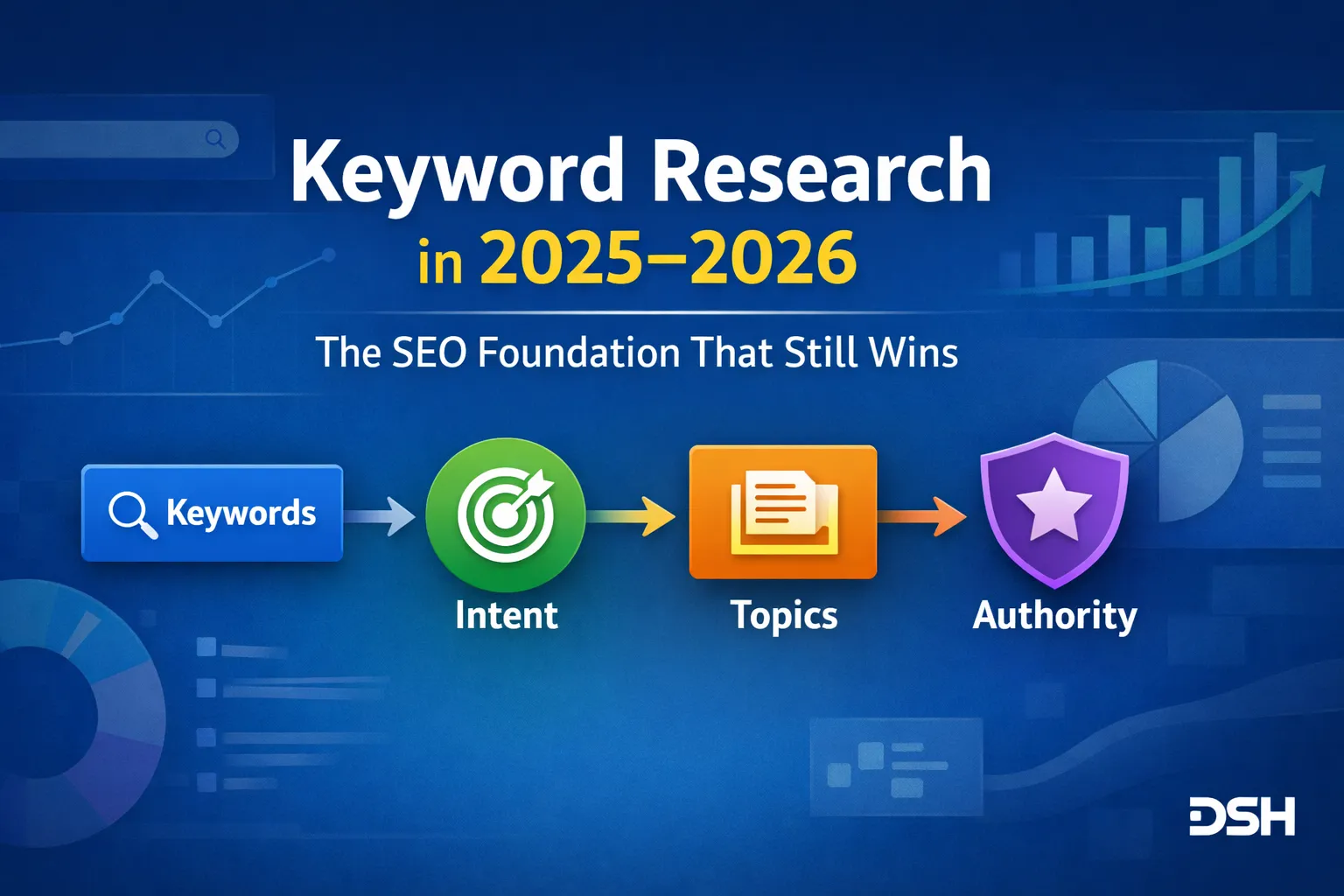
Despite the rise of AI-powered search, Google AI Overviews, and conversational results, keyword research remains the decision-making backbone of SEO. Every ranking page, featured snippet, AI citation, and Discover placement is still driven by structured language patterns — not guesswork.
What has changed in 2025–2026 is how keyword research is executed. SEO is no longer about ranking for a single keyword. It is about:
- Understanding search intent
- Building topical authority
- Covering entities and semantic variations
- Aligning content with user expectations
Without keyword research, SEO becomes reactive, inconsistent, and impossible to scale.
Before executing any keyword plan, review our complete SEO audit framework to ensure your technical foundation supports ranking growth.
What Is Keyword Research?
According to Google’s SEO Starter Guide , keyword research is the foundation of search visibility.
Keyword research is the process of discovering the words and phrases people use in search engines when they want to learn something, compare options, or take action.
Modern keyword research answers critical strategic questions:
- What problems users are trying to solve
- Which topics Google expects authority on
- What format and depth users expect
- Which keywords drive qualified traffic
Keyword research is not just about traffic volume. It is about relevance, intent, and outcomes.
In 2025, successful SEO strategies start with keyword research and end with conversions — not rankings alone.
Why Keyword Research Matters More Than Ever in 2025–2026
There is a common misconception that AI has made keywords obsolete. This belief is incorrect.
AI systems still rely on structured language, topic relationships, and intent signals. Keyword research is how humans communicate relevance to machines.
Here is why keyword research is more important than ever:
- Search competition is at an all-time high
- Thin content is aggressively filtered
- Topical depth outperforms isolated pages
- User intent determines rankings
Google no longer rewards pages that simply mention a keyword. It rewards pages that fully satisfy the intent behind that keyword.
Keyword research provides the blueprint for doing exactly that.
Types of Keywords (With Practical Examples)
Short-Tail Keywords
Short-tail keywords are broad terms such as SEO or keyword research. These keywords have high search volume but extremely high competition.
They are useful for long-term authority building but rarely convert on their own.
Long-Tail Keywords
Long-tail keywords are more specific phrases such as keyword research for small business websites.
These keywords:
- Have lower competition
- Match clearer intent
- Convert at higher rates
Most successful SEO growth comes from long-tail keywords, not head terms.
Commercial Keywords
Commercial keywords indicate comparison or evaluation intent. Examples include:
- best keyword research tools
- ahrefs vs semrush
- seo software comparison
These keywords are ideal for blog posts that lead into services or products.
Transactional Keywords
Transactional keywords indicate readiness to take action. Examples include:
- hire seo consultant
- keyword research services
- seo audit pricing
These keywords belong on service pages, not blog posts.
Understanding Search Intent (The #1 Ranking Factor)
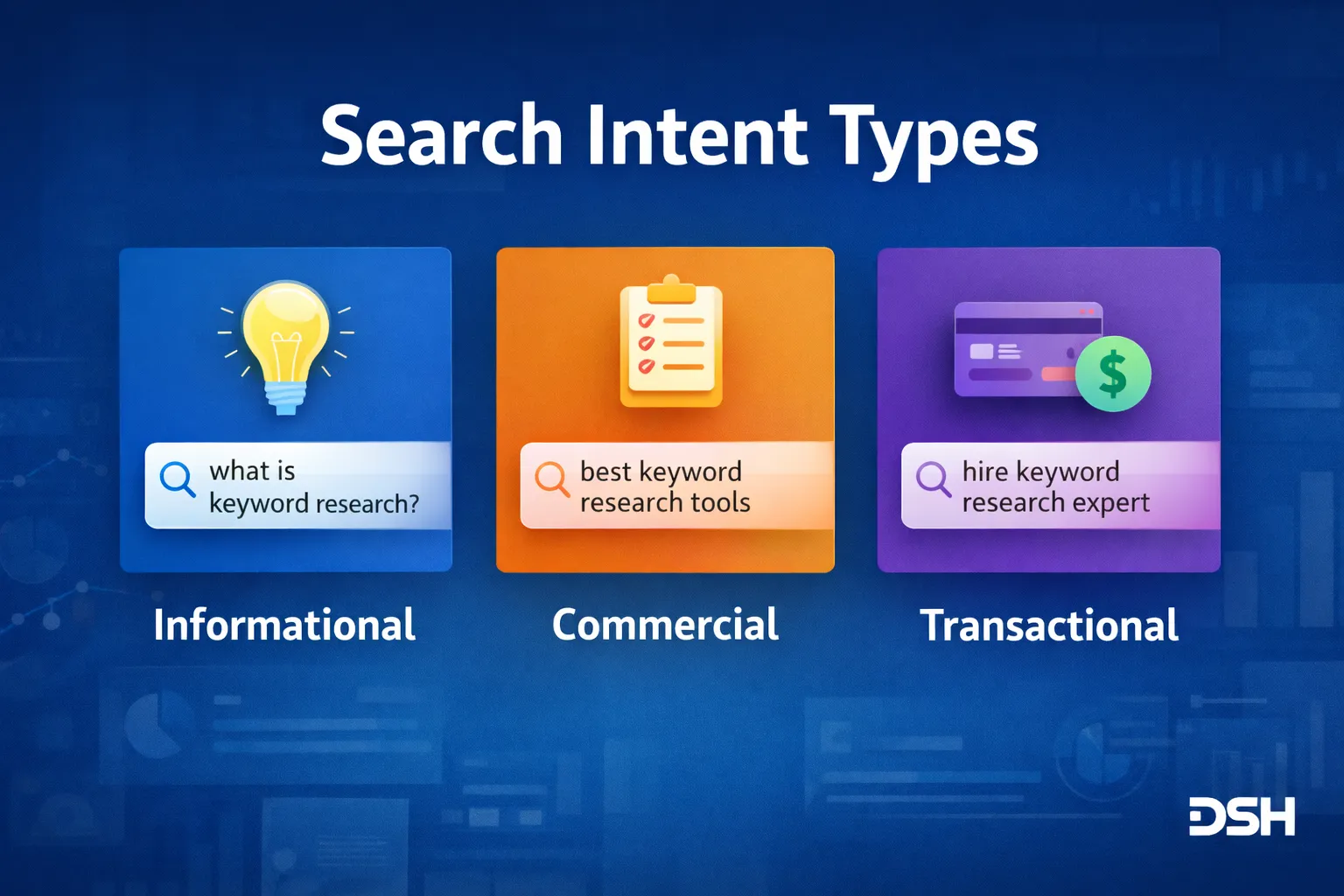
Search intent is the reason behind a user’s query. Google ranks pages based on how well they satisfy that intent.
There are three core intent types:
- Informational: learning or researching
- Commercial: comparing options
- Transactional: ready to act or buy
For example:
- what is keyword research → informational
- best keyword research tools → commercial
- hire keyword research expert → transactional
If your content does not match the dominant intent of the query, it will not rank — regardless of keyword usage.
This is why intent analysis is the foundation of modern keyword research.
Keyword Research vs Topic Research
In older SEO models, one page targeted one keyword.
In modern SEO, one page targets an entire topic made up of many related keywords.
Keyword research feeds topic research by:
To understand how keyword research supports broader optimization, review our Technical SEO fundamentals guide.
- Identifying semantic variations
- Revealing subtopics users expect
- Preventing keyword cannibalization
This shift is what enables topical authority and long-term rankings.
Keyword research is no longer about individual terms — it is about building complete answers.
The Modern Keyword Research Process (Step-by-Step)
Before publishing content, review our complete SEO audit checklist to ensure technical readiness.
In 2025–2026, effective keyword research follows a structured system. Skipping steps leads to wasted content, poor rankings, and low conversions.
Step 1: Define Core Topics (Authority Mapping)
Start by identifying your core topics — these are the themes you want Google to associate with your website.
For example:
- SEO & Technical SEO
- Keyword research
- AI tools & automation
- Freelancing & portfolio building
- Website migration & audits
Each core topic becomes a pillar that supports multiple related pages.
This prevents random publishing and builds topical authority over time.
Step 2: Keyword Expansion (Beyond Basic Tools)
Keyword expansion means uncovering every relevant variation users search for — not just high-volume terms.
Use a combination of:
- Google Search Console (real user queries)
- Google Autosuggest & People Also Ask
- Ahrefs / SEMrush keyword explorer
- Competitor ranking keywords
At this stage, volume matters less than relevance and intent.
A keyword with 50 searches per month but perfect intent can outperform a 5,000-volume keyword that does not convert.
Step 3: SERP Analysis (Reverse Engineering Rankings)
Before targeting any keyword, analyze the search results. Our detailed guide on SERP competition analysis explains how to evaluate ranking pages, domain authority, and content gaps before writing SEO content.
Ask these questions:
- Are ranking pages blog posts, guides, or service pages?
- What is the average content length?
- Do results include videos, lists, or tools?
- Is Google favoring freshness or authority?
This tells you what Google expects for that query.
If the top 10 results are 3,000-word guides, a 700-word article will not rank — regardless of optimization.
Step 4: Competitor Keyword Gap Analysis
Competitor analysis is not about copying — it’s about finding weaknesses.
Look for:
- Keywords competitors rank for with weak content
- Subtopics they mention briefly but don’t cover deeply
- Outdated information you can improve
The goal is not to be different — the goal is to be better.
In many cases, improving structure, intent alignment, and depth is enough to outrank established competitors.
Step 5: Keyword Clustering (Critical for 2025 SEO)
To see practical implementations of keyword clustering and validation, explore these detailed guides:
- How to Validate a Keyword Before Writing Content
- Keyword Difficulty Explained (SEO Competition Guide)
- SERP Competition Analysis Framework
- Low Competition Keyword Strategy for Ranking Faster
- How Many Keywords Should You Target Per Page?
- LSI Keywords vs Semantic SEO: What Actually Matters?
- Keyword Research for Brand New Websites
Keyword clustering means grouping semantically related keywords into a single authoritative page.
Instead of creating:
- keyword research tools
- keyword research software
- best keyword tools
For performance data, always validate keyword insights inside Google Search Console.
You create one comprehensive page covering all variations.
Benefits of clustering:
- Avoids keyword cannibalization
- Builds topical authority
- Ranks for hundreds of long-tail queries
This is how modern SEO scales without bloating your site.
Large-Scale Keyword Research: Segment Before You Write
Large-scale keyword research is the process of organizing thousands of search queries into clusters by intent and SERP overlap, so each cluster is mapped to a single page instead of many competing pages.
For larger sites, the main bottleneck is not generating more keywords; it is deciding which queries belong together and which deserve separate pages. A scalable process uses consistent fields so thousands of terms can be filtered before content is assigned.
| Field | What to record | Decision |
|---|---|---|
| Query | Exact search phrase and close variants | Keep, merge, or discard |
| Intent | Informational, commercial, transactional, or mixed | Choose the page format |
| SERP overlap | Whether the same pages rank for the queries | Cluster or split |
| Business value | Relevance to the offer and conversion path | Prioritize the work |
| GSC evidence | Existing impressions, clicks, CTR, and position | Refresh or create the URL |
Practical rule: do not split keywords into separate pages just because the wording differs. Split them when the dominant intent, SERP results, or required page format is materially different. This reduces cannibalization while keeping the site architecture understandable.
Keyword Mapping (Turning Research into Pages)
Keyword mapping assigns keyword clusters to specific URLs.
Before assigning keywords to pages, it is important to validate whether the keyword is worth targeting. This is explained in our guide on keyword validation before writing content.
Each page should have:
- One primary keyword (core intent)
- Multiple secondary keywords
- Semantic variations and entities
Never assign the same primary keyword to multiple pages.
This prevents internal competition and improves crawl efficiency.
On-Page Keyword Optimization (What Actually Works)
Keyword placement is not about repetition — it’s about context.
- Title tag aligned with intent
- Clean, readable URL slug
- H1 that matches search intent
- H2/H3 supporting subtopics
- First 100 words establish relevance
Avoid forcing exact matches. Google understands variations and synonyms.
Clarity beats density.
Internal Linking & Keyword Strategy
If you want to see how keyword planning impacts large-scale changes, explore our website migration SEO case study, where we break down ranking recovery through structured internal linking and intent mapping.
Internal links help search engines understand topic relationships.
Use keyword research to:
- Link from supporting articles to pillar pages
- Use descriptive, natural anchor text
- Distribute authority across related pages
Internal links are one of the most underused ranking factors — yet entirely under your control.
Common Keyword Research Mistakes (That Kill Rankings)
- Choosing keywords without intent analysis
- Chasing volume instead of relevance
- Creating multiple pages for the same topic
- Over-optimizing exact-match keywords
- Ignoring internal linking strategy
Most ranking failures are caused by poor planning — not poor writing.
Keyword Research for Different Website Types
For newly launched domains, start with our SEO audit framework for new websites to avoid early indexing issues and keyword targeting mistakes.
Blogs & Content Sites
- Informational intent
- Topic clusters
- Authority building
Service-Based Websites
- Commercial + transactional intent
- Location and service modifiers
- Conversion-focused pages
E-commerce Websites
- Category keywords
- Product-based long tails
- Filter and attribute searches
Keyword research adapts to business models — not the other way around.
If you want to find keywords that are easier to rank for, review our low competition keyword strategy guide.
Keyword Research in the Age of AI & Google AI Overviews
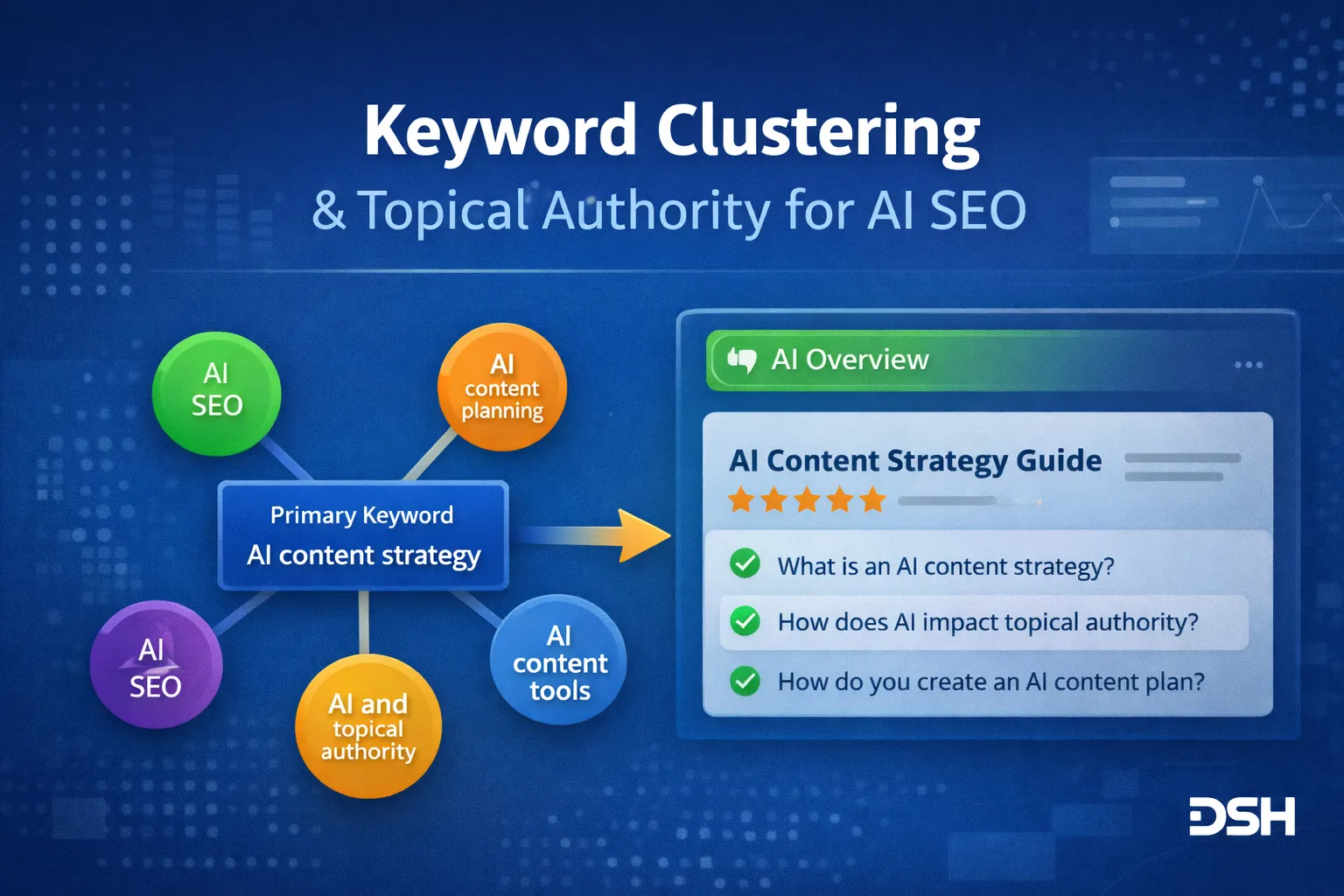
To understand how keyword research integrates with AI-driven ranking systems, review our SEO and AI content strategy guide, which explains how to optimize for AI Overviews and semantic search.
AI-powered search has changed how results are displayed, not how relevance is calculated.
Google’s AI Overviews, Discover, and SGE-style experiences still rely on:
- Search intent alignment
- Topical authority
- Semantic keyword relationships
- Structured content
Keyword research is now about entities, context, and coverage — not exact-match repetition.
How to Optimize Keyword Research for AI Overviews
To appear in AI-generated answers, content must be:
- Comprehensive (covers the topic fully)
- Clearly structured (headings + lists)
- Fact-based and explanatory
- Supported by FAQs and definitions
AI prefers pages that answer multiple related questions in one place.
That is why long-form, clustered keyword content performs better in 2025–2026.
Entity-Based Keyword Research (Advanced)
Entities are people, tools, concepts, or brands that Google understands independently.
For keyword research, this means:
- Cover related tools (Ahrefs, SEMrush, GSC)
- Explain concepts (search intent, clustering)
- Use natural synonyms and variations
You are no longer optimizing for a keyword — you are optimizing for a topic ecosystem.
Scaling Keyword Research Without Losing Quality
As websites grow, keyword research must scale responsibly.
Best practices:
- Create pillar pages for major topics
- Support them with focused sub-articles
- Audit keyword cannibalization quarterly
- Update existing content instead of publishing duplicates
If you notice indexing inconsistencies after restructuring URLs, read our guide to fixing page with redirect issues in Google Search Console to preserve keyword rankings and crawl efficiency.
Growth comes from consolidation, not content explosion.
Keyword Research Checklist (2025–2026)
- ✔ Identify core topics
- ✔ Analyze intent before volume
- ✔ Study SERP patterns
- ✔ Use keyword clustering
- ✔ Map keywords to URLs
- ✔ Optimize context, not density
- ✔ Strengthen internal links
- ✔ Refresh content regularly
Need Help With Keyword Strategy?
We provide done-for-you keyword research, intent mapping, clustering frameworks, and SEO content strategy tailored for scalable organic growth.
Request Keyword Research Strategy →Frequently Asked Questions (40+)
1. What is keyword research in SEO?
Keyword research is the process of identifying and analyzing search terms users type into search engines.
2. Is keyword research still important in 2025?
Yes. Even AI-powered search relies on structured keyword-based content.
3. How many keywords should one page target?
One primary keyword with multiple related semantic keywords.
4. What are long-tail keywords?
Specific, lower-volume phrases with higher conversion intent.
5. What is search intent?
The reason behind a user’s search query.
6. Why does intent matter more than volume?
Because intent determines relevance and conversions.
7. What is keyword clustering?
Grouping related keywords into one authoritative page.
8. What is keyword cannibalization?
When multiple pages compete for the same keyword.
9. How do I fix keyword cannibalization?
Merge content or reassign keyword targets.
10. Are FAQs good for SEO?
Yes. FAQs capture long-tail searches and enable rich results.
11. How often should keyword research be updated?
Every 6–12 months or after major Google updates.
12. Can one page rank for multiple keywords?
Yes, if the content is comprehensive.
13. Do exact-match keywords still matter?
Less than before. Context and intent matter more.
14. What tools are best for keyword research?
Google Search Console, Ahrefs, SEMrush, and Keyword Planner.
15. How does AI affect keyword research?
AI prioritizes topic coverage and clarity.
16. Should I optimize for AI Overviews?
Yes, by answering questions clearly and completely.
17. Are low-volume keywords worth targeting?
Yes, if they match strong intent.
18. How many words should a ranking article have?
As many as needed to fully satisfy intent.
19. What is topical authority?
Being recognized as an expert on a subject.
20. How long does keyword research take?
From hours for small sites to weeks for large ones.
21. Can keyword research increase conversions?
Yes, by targeting buyer-intent searches.
22. Is keyword research different for blogs vs services?
Yes. Blogs target information, services target transactions.
23. What is semantic SEO?
Optimizing content based on meaning, not repetition.
24. Should keywords be in headings?
Yes, naturally where relevant.
25. Can internal links affect keyword rankings?
Yes, significantly.
26. Do images help keyword relevance?
Yes, when properly described.
27. What is SERP analysis?
Studying ranking pages to understand expectations.
28. How do I find keyword gaps?
Compare your rankings to competitors.
29. Is keyword research a one-time task?
No. It is ongoing.
30. What is the biggest keyword research mistake?
Ignoring intent.
31. Should I target zero-search keywords?
Sometimes, for authority and AI visibility.
32. How does Google understand keywords?
Through entities, context, and intent.
33. What is a pillar page?
A comprehensive page covering a core topic.
34. How many FAQs should a page have?
As many as are genuinely useful.
35. Does FAQ schema guarantee rich results?
No, but it increases eligibility.
36. Can keyword research help Discover traffic?
Yes, by aligning with trending topics.
37. Should I update old keyword research?
Yes, regularly.
38. Can AI tools replace keyword research?
No. They assist, not replace strategy.
39. Is keyword research different for local SEO?
Yes, location modifiers matter.
40. What is the future of keyword research?
Intent-driven, entity-based, and AI-aligned.
Explore More SEO Strategy Guides
- Technical SEO Mastery Guide
- Complete SEO Audit Framework
- Website Migration SEO Checklist
- Fix Crawled – Currently Not Indexed
- 301 Redirect Strategy Guide
- How to Validate a Keyword Before Writing Content
- Keyword Difficulty Explained
- SERP Competition Analysis
- Low Competition Keywords Strategy
- How Many Keywords Per Page
- LSI vs Semantic SEO
- Keyword Research for New Websites
- Keyword Clustering: How to Group SEO Keywords
- Long-Tail Keyword Strategy
- Competitor Keyword Gap Analysis
- Commercial vs Transactional Keywords
- Informational vs Navigational Keywords
- Predictive Keyword Research Strategy
- Zero Search Volume Keywords
Final Takeaway: Keyword Research Is the Strategy Behind Every Ranking
Keyword research is not a checklist item — it is the strategic foundation of modern SEO. In 2025–2026, rankings are no longer driven by keyword repetition, shortcuts, or volume chasing. They are driven by intent alignment, topical authority, and structured content that answers real user questions.
The websites that win are the ones that:
- Understand why users search — not just what they search
- Build comprehensive topic coverage instead of isolated pages
- Use keyword clustering to avoid cannibalization
- Support content with internal links, FAQs, and entities
- Optimize for both humans and AI-powered search systems
If you master keyword research, everything else in SEO becomes easier — content planning, internal linking, Discover visibility, AI Overviews, and long-term organic growth.
Keyword research is not dead. It has evolved into the blueprint behind sustainable search visibility.