
E-Commerce SEO · Audit Checklist · Technical SEO
Updated for 2026: This is one of the most complete ecommerce SEO audit checklists available, covering technical SEO, product optimization, and advanced ranking strategies.
Struggling to rank your ecommerce store or losing traffic? This 92-point SEO audit checklist will help you identify and fix the exact issues stopping your growth.
A practical, step-by-step e-commerce SEO audit that lists 92 critical fixes across technical, on-page, product & schema, content, UX, and backlink areas.
Quick Ecommerce SEO Audit Checklist
Bonus: Download a printable ecommerce SEO audit checklist (coming soon).
- Fix indexing and crawl errors
- Optimize product pages and metadata
- Improve internal linking structure
- Implement structured data (schema)
- Improve page speed and Core Web Vitals
- Fix duplicate content issues
Updated: April 2026 • Estimated read: 22-25 min • Author: Hassan
The Complete E-Commerce SEO Audit Guide (2026)
Most ecommerce websites lose 30–70% of potential traffic due to technical SEO issues and poor product optimization.
Running an e-commerce website without performing regular SEO audits is one of the most common reasons online stores struggle to grow organic traffic. Many store owners invest heavily in advertising, influencer campaigns, and social media marketing, yet overlook the technical and structural issues that prevent their website from ranking in search engines.
An e-commerce SEO audit identifies the hidden problems that affect search visibility, indexing, and organic rankings. These issues often include crawl errors, duplicate content, weak product pages, poor internal linking, slow page speed, and missing structured data.
When these problems accumulate across hundreds or thousands of pages, search engines struggle to understand the website properly. As a result, product pages fail to rank, category pages lose visibility, and organic traffic remains stagnant.
A structured SEO audit helps fix these problems systematically.
If you are just starting, read our keyword research guide for new websites to build a strong SEO foundation.
In this guide, we will walk through a complete 92-point ecommerce SEO audit framework used by professional SEO consultants to improve organic traffic, fix technical issues, and strengthen search engine visibility.
This guide applies to most ecommerce platforms including:
- Shopify stores
- WooCommerce websites
- Magento ecommerce platforms
- Custom ecommerce frameworks
- Marketplace integrations
If your store contains hundreds or thousands of products, this audit process will help you prioritize the highest-impact improvements first.
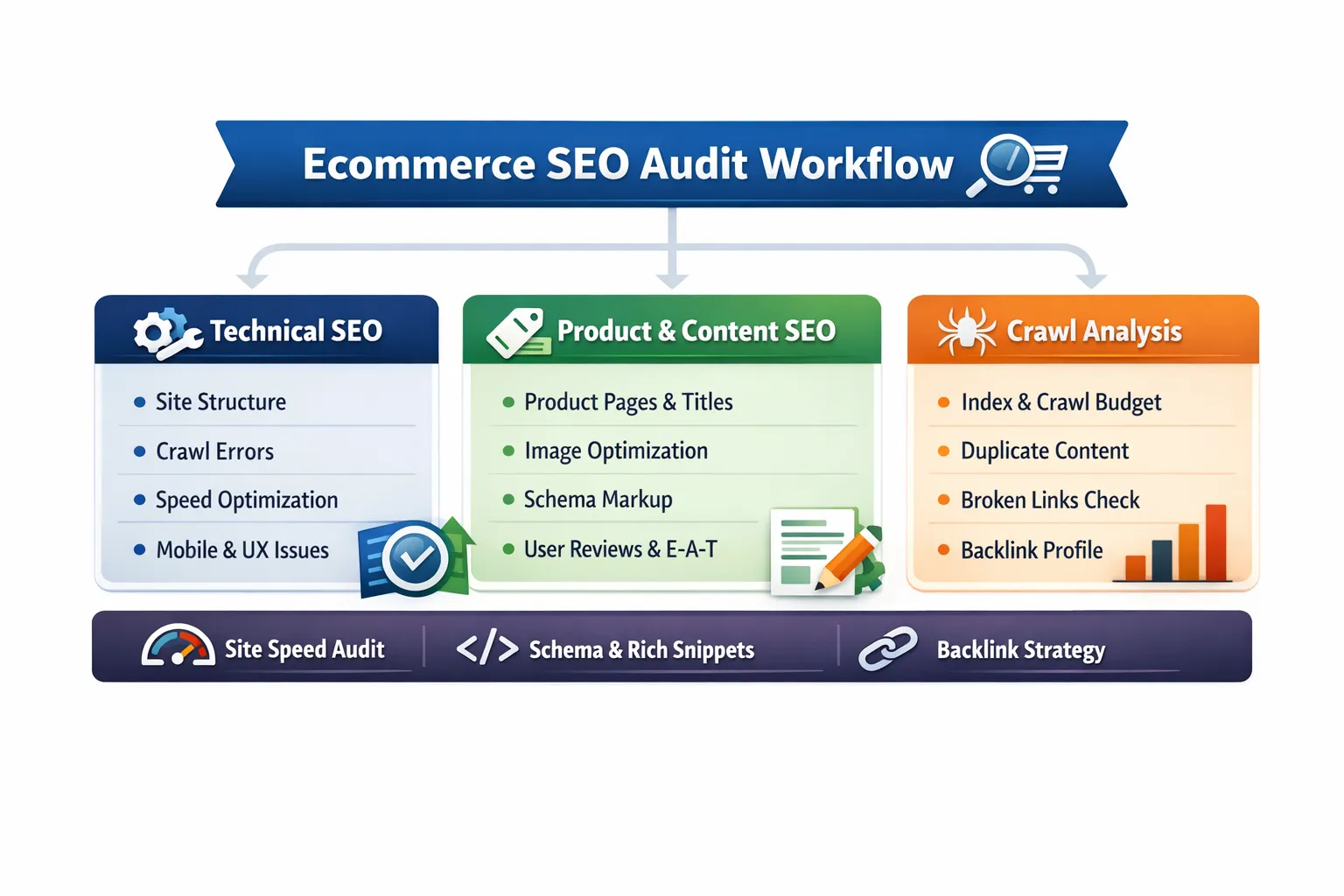 Ecommerce SEO audit workflow showing technical, content and performance optimization stages
Why E-Commerce SEO Audits Are Critical for Organic Growth
E-commerce websites are structurally complex compared to most other types of websites. A small blog may contain 20–50 pages, but an online store can easily contain thousands of product URLs, multiple category pages, filters, sorting parameters, and pagination.
This complexity introduces a variety of SEO challenges.
- Duplicate product pages created by filters and variants
- Indexation problems caused by improper canonical tags
- Thin product descriptions copied from manufacturers
- Slow page load times due to large product images
- Weak internal linking between products and categories
- Poor structured data implementation
Without regular audits, these issues accumulate and prevent search engines from properly understanding the website.
If you recently migrated your site, follow our SEO migration checklist to avoid traffic loss.
According to the Google Search SEO Starter Guide , websites should regularly review crawlability, indexing signals, and content quality to maintain strong search performance.
Large ecommerce sites especially benefit from frequent SEO audits because even small technical errors can affect hundreds of pages simultaneously.
For example, an incorrect canonical tag applied to a category template may accidentally de-index dozens of pages from search results.
Similarly, improper pagination configuration can cause search engines to crawl thousands of low-value URLs instead of focusing on important pages.
By performing a comprehensive audit, these issues can be discovered early and corrected before they impact rankings significantly.
How Search Engines Evaluate Ecommerce Websites
Search engines such as Google use complex ranking algorithms to evaluate ecommerce websites. These algorithms analyze hundreds of signals to determine which pages should appear in search results.
While the exact algorithm is proprietary, several major factors consistently influence ecommerce rankings.
To better understand rankings, read our guide on search intent and SERP analysis.
1. Crawlability
Search engines must be able to crawl your website efficiently. If robots.txt blocks important pages or if navigation creates crawl traps, search engines may fail to discover key product pages.
2. Indexability
Even if pages are crawled, they may not be indexed if canonical tags, meta robots directives, or duplicate content issues exist.
3. Content Quality
Product pages with thin descriptions or duplicate manufacturer text rarely rank well. Search engines prefer pages that provide useful and unique information for shoppers.
4. Structured Data
Structured data helps search engines understand important information such as price, availability, product ratings, and reviews.
Google recommends implementing Product Schema to improve product visibility in search results.
5. Page Experience
Page speed and user experience signals play a major role in modern search rankings. Google's Core Web Vitals measure loading performance, visual stability, and responsiveness.
6. Authority & Backlinks
Backlinks from authoritative websites signal trust and relevance. Ecommerce websites with strong backlink profiles generally rank higher for competitive product keywords.
Most Common Ecommerce SEO Mistakes
During professional ecommerce audits, several recurring issues appear across different websites regardless of platform or industry.
Understanding these mistakes can help store owners prioritize improvements more effectively.
Duplicate Product Content
Many ecommerce stores copy product descriptions directly from manufacturers. Because hundreds of other websites use the same text, search engines struggle to determine which page should rank.
Writing unique product descriptions significantly improves ranking potential.
Poor Category Page Optimization
Category pages often target broad high-volume keywords such as “running shoes” or “wireless headphones”. However, many ecommerce websites leave category pages with little or no descriptive content.
Adding helpful category descriptions improves relevance and search visibility.
Weak Internal Linking
Internal links help distribute authority across the website and guide search engines toward important pages.
Strategic internal linking between blog content, categories, and product pages strengthens overall SEO performance.
You can learn more about internal linking strategies in our guide on SEO content clusters and internal linking.
Slow Page Speed
Large images, excessive scripts, and poor hosting infrastructure frequently slow down ecommerce websites.
According to Google Web Vitals documentation , fast loading pages improve both user experience and ranking signals.
The 92-Step Ecommerce SEO Audit Framework
The audit process presented in this article is divided into multiple categories so that technical teams, SEO specialists, and content managers can address issues in a structured order.
Rather than attempting to fix everything at once, this framework prioritizes improvements based on their impact on search visibility.
Phase 1: Technical SEO Analysis
This phase focuses on crawlability, indexing signals, server responses, structured data, and canonical tags.
Phase 2: On-Page Optimization
On-page improvements include optimizing title tags, headings, product descriptions, metadata, and internal linking structures.
Phase 3: Content & Category Improvements
Content optimization improves category page relevance, blog content strategy, and topical authority.
Phase 4: UX & Performance
Site speed improvements and Core Web Vitals optimization improve both user experience and search engine ranking signals.
Phase 5: Authority Building
The final phase focuses on backlink analysis, outreach strategies, and restoring lost link equity.
Together, these phases form the foundation of a professional ecommerce SEO audit.
 Major ranking factors that influence ecommerce search visibility
Additional Resources for Improving Ecommerce SEO
If you are building an ecommerce SEO strategy, you may also find these resources helpful:
- SEO migration checklist
- Professional SEO services and consulting
- Latest SEO strategy articles and tutorials
- SEO portfolio and case studies
- Request a custom ecommerce SEO audit
These resources provide additional insights into keyword research, technical SEO strategies, and content optimization techniques used to improve organic rankings.
Audit summary & priorities
E-commerce stores face a mix of technical complexity: thousands of product pages, faceted navigation, and frequent price/stock changes. This audit lists 92 actionable fixes, grouped by priority so you can triage work:
Quick triage: Start with indexability, canonical issues, and server response (P0). Then move to product schema, on-page optimization, and page speed (P1). After that, address content depth, internal linking, and backlinks (P2/P3).
 Illustration: real audit collaboration style
Technical Foundations of Ecommerce SEO
Before implementing specific SEO fixes, it is important to understand the technical architecture of ecommerce websites and how search engines interact with them. Technical SEO forms the foundation that allows search engines to crawl, interpret, and rank pages efficiently.
Unlike simple informational websites, ecommerce stores contain dynamic pages generated through filters, categories, product variants, and pagination. These dynamic elements can unintentionally create thousands of URLs that search engines must process.
If these URLs are not properly controlled, they can waste crawl budget, dilute ranking signals, and cause index bloat.
A technical ecommerce SEO audit focuses on ensuring that search engines crawl only valuable pages while ignoring low-value or duplicate URLs.
 Typical ecommerce site architecture structure connecting homepage, category pages and product listings
How Search Engines Crawl Ecommerce Websites
Search engines discover pages through links. When Googlebot visits a website, it follows internal and external links to find new content.
On ecommerce websites, this process becomes complicated due to faceted navigation systems such as filters, sorting options, color variations, and pagination.
For example, a category page might generate URLs like:
/shoes/
/shoes?color=black
/shoes?size=10
/shoes?sort=price
/shoes?page=2
Each parameter creates a new URL variation. Without proper canonicalization or indexing rules, search engines may crawl thousands of unnecessary pages.
According to the Google Crawling Documentation , websites should ensure that important content is easily accessible while minimizing crawl waste.
A well-structured ecommerce site ensures that search engines focus primarily on:
- Category pages
- Product pages
- Important blog content
- High-value landing pages
Lower-value URLs such as filter combinations should typically be excluded from indexing.
Understanding Crawl Budget for Large Ecommerce Websites
Crawl budget refers to the number of pages a search engine crawler will visit on a website within a given period. For small websites, crawl budget is rarely an issue. However, large ecommerce stores with thousands of pages must manage crawl efficiency carefully.
When search engines spend time crawling low-value pages, they may delay discovering or re-crawling important product pages.
Common causes of crawl budget waste include:
- Faceted navigation URLs
- Duplicate product variants
- Broken links
- Redirect chains
- Thin or low-value pages
SEO tools such as Screaming Frog SEO Spider can help identify crawl inefficiencies and highlight unnecessary URLs.
Improving crawl efficiency helps search engines discover and index important pages faster.
Indexation Management for Ecommerce Websites
Indexation determines which pages appear in search results. Even if pages are crawled successfully, they may not be indexed if search engines consider them low value or duplicates.
Ecommerce websites frequently struggle with indexation problems due to duplicated product descriptions, variant URLs, and automatically generated pages.
Effective indexation management requires controlling which pages should be indexed and which should remain excluded.
Common indexation signals include:
- Canonical tags
- Meta robots directives
- Robots.txt rules
- XML sitemaps
Search engines rely on these signals to determine which URLs represent the primary version of a page.
Google recommends maintaining a clear canonical structure to prevent duplicate content issues. Detailed documentation can be found in the Google canonicalization guidelines .
Structured Data for Ecommerce SEO
Structured data helps search engines understand the meaning of content on a webpage. Ecommerce websites particularly benefit from structured data because product information can be displayed directly in search results.
Structured data is typically implemented using JSON-LD markup based on the Schema.org vocabulary .
Product schema allows search engines to display important information such as:
- Product price
- Availability status
- Customer ratings
- Product reviews
- Brand information
These elements may appear as rich results within search listings, improving click-through rates.
Google provides detailed documentation on product structured data in the Product structured data guidelines .
 Example of product rich results generated through structured data markup
Implementing structured data correctly can significantly improve product visibility in search results.
Internal Linking Structure for Ecommerce Sites
Internal linking is one of the most powerful yet underutilized SEO strategies for ecommerce websites. Proper internal linking distributes authority across the website and helps search engines understand the relationship between pages.
A strong internal linking structure connects key page types including:
- Homepage
- Category pages
- Product pages
- Blog content
For example, blog articles discussing product comparisons should link to the relevant product category pages.
Similarly, category pages should highlight best-selling products using contextual links.
If you want to learn more about content clusters and SEO architecture, explore our SEO blog resources.
Strategic internal linking improves crawlability and helps search engines distribute ranking signals throughout the site.
If your traffic dropped after site changes, check our SEO recovery guide.
Technical SEO Audit Summary
Technical SEO provides the structural framework that allows ecommerce websites to rank effectively in search engines.
Without proper technical optimization, even the best product content may struggle to appear in search results.
A professional ecommerce SEO audit therefore begins with technical analysis before moving to on-page and content improvements.
In the next section, we will examine the 30 most important technical SEO fixes that should be implemented to ensure proper crawlability, indexing, and search engine visibility.
| Area | Impact | Difficulty |
|---|---|---|
| Technical SEO | High | Medium |
| Product Optimization | High | Low |
| Internal Linking | Very High | Low |
| Backlinks | Very High | High |
Technical SEO fixes (1–30)
Goal: make sure Google can crawl, index and correctly render your catalog pages without duplication, crawl traps, or unnecessary parameters.
If you recently migrated your store, follow our SEO migration checklist to prevent traffic loss.
1–6: Indexability & crawl
- Check robots.txt — ensure `/sitemap.xml` is allowed and disallowed paths (admin, cart, checkout) are blocked. Use Google Search Console (GSC) > Coverage to spot blocked but important pages.
- Verify sitemaps — submit separate sitemaps: `sitemap-products.xml`, `sitemap-categories.xml`, and `sitemap-blog.xml`. Keep each sitemap < 50k URLs or use sitemap index files.
- Canonicalization — ensure every product, category and pagination page has a correct ` `. Avoid self-referencing canonicals that point to different variants (size/color) without explanation.
- Parameter handling — identify faceted navigation (sort, filter) and either canonicalize to the main view or use `noindex,follow` for filtered pages to avoid duplicate content.
- Index bloat — locate low-value indexable pages (tag pages, thin facets) and `noindex` or canonicalize them to main category pages.
- Host canonical domains — pick one (www or non-www) and redirect the other via 301; set canonical and sitemap URLs to the preferred host.
7–12: Server & response
- Fix 5xx / 4xx errors — scan server logs and GSC; replace soft 404s with proper 404 or redirect to relevant pages (avoid redirecting everything to homepage).
- Ensure correct HTTP headers — add `X-Robots-Tag` where needed (for PDFs, feeds) and make sure caching headers are set for static assets.
- Use HTTP/2 or HTTP/3 — if the host supports HTTP/3, enable it for faster multiplexed requests.
- Set up a CDN — deliver images, JS and CSS from CDN to reduce time to first byte (TTFB) globally.
- Mobile first — ensure mobile and desktop versions are consistent. Use responsive design, not separate mobile pages that can create duplicate content.
- Clean redirect chains — replace long chains with direct 301s and confirm the final status is 200.
13–20: Structured data & product pages
- Product schema (required) — add `Product` schema with `name`, `image`, `description`, `sku`, `brand`, `offers` (price, currency, availability), and `aggregateRating` where available. Use structured data testing tools to validate.
- Offer structured data freshness — update `price` and `availability` in schema via server-side render or dynamic JSON-LD updated at render time to avoid mismatch errors.
- Breadcrumb schema — implement `BreadcrumbList` on categories and product pages to improve SERP display.
- Canonical + schema match — ensure the `@id`/URL in schema matches the canonical URL.
- Pagination schema — handle category pagination using `rel=next/prev` or canonical to main category page if you prefer consolidated signals.
- Fix duplicate product pages — if variants create separate pages, consider consolidated canonical or variant attributes to avoid splitting signals.
21–30: Security & crawl budget
- Robust 301/302 handling — ensure temporary redirects are only used when truly temporary.
- Block low-value parameters — use URL parameter tools in GSC or canonicalize filtered URLs.
-
Clean sitemap priority & lastmod — set realistic `
` and ` ` flags for frequently updated products. - Check crawl budget — avoid indexable duplicates, limit auto-generated pages, and keep orphan pages out of indexation.
- Enable HSTS & TLS 1.3 — security best practices improve performance and trust.
- Robots txt sitemap line — add `Sitemap: https://yourdomain.com/sitemap_index.xml` to robots.txt.
Product Page SEO Optimization for Ecommerce Stores
Product pages are the most important revenue-generating pages on any ecommerce website. When optimized correctly, these pages can rank for highly transactional keywords such as “buy running shoes online”, “best wireless headphones price”, or “men's leather wallet”.
However, many ecommerce websites fail to fully optimize their product pages for search engines. Instead, they rely on short manufacturer descriptions, minimal content, and weak metadata.
Search engines prefer product pages that provide useful information for shoppers while clearly communicating product relevance.
You can also improve rankings using proper keyword validation. See our keyword validation guide.
An optimized product page typically includes:
- Unique product title and keyword targeting
- Detailed product descriptions
- Clear product specifications
- Customer reviews and ratings
- Structured data markup
- Internal links to related products
According to the Google Product Structured Data documentation , providing complete product information helps search engines display rich results in search listings.
 Key SEO elements of an optimized ecommerce product page
Keyword Strategy for Ecommerce Websites
Successful ecommerce SEO begins with a clear keyword targeting strategy. Unlike informational blogs, ecommerce websites must focus heavily on transactional and commercial-intent keywords.
Many websites now target long-tail keywords such as ecommerce SEO audit checklist for beginners, ecommerce SEO audit step by step, and Shopify ecommerce SEO audit guide to capture low-competition traffic.
These keywords indicate that users are actively searching for products or comparing purchase options.
Common ecommerce keyword categories include:
If you are new to SEO, read our guide on keyword research strategies for new websites
Transactional Keywords
- buy running shoes online
- cheap wireless earbuds
- gaming laptop price
Commercial Investigation Keywords
- best running shoes for flat feet
- top wireless headphones 2025
- best mechanical keyboards
Brand + Product Keywords
- Nike Air Zoom review
- Samsung Galaxy buds price
- Apple AirPods comparison
Keyword research tools such as Ahrefs Keyword Generator or SEMrush Keyword Research Tool can help identify high-value keywords relevant to ecommerce products.
Once target keywords are identified, they should be strategically placed in:
- Title tags
- Product page headings
- Category descriptions
- Internal links
- Image alt text
A strong keyword strategy ensures that both category pages and product pages rank for relevant search queries.
Category Page SEO Optimization
Category pages are among the most powerful ranking pages on ecommerce websites. These pages often target broader high-volume keywords such as “running shoes”, “wireless headphones”, or “gaming keyboards”.
Because category pages list multiple products, they help search engines understand the relationship between products and topics.
Well-optimized category pages typically include:
- Clear keyword-focused titles
- Helpful category descriptions
- Internal links to featured products
- Filter and sorting controls
- Breadcrumb navigation
Adding unique category descriptions also helps search engines understand the purpose of the page.
For example, a category page selling running shoes might include a short introduction explaining different types of running shoes and how to choose the right pair.
This type of content improves both user experience and SEO relevance.
 Example structure of a well optimized ecommerce category page
Content Marketing for Ecommerce SEO
Content marketing plays an important role in ecommerce SEO because it allows websites to target informational and comparison keywords that attract potential customers earlier in the buying journey.
While product pages target transactional keywords, blog content targets informational queries such as:
- how to choose running shoes
- best headphones for working out
- gaming keyboard buying guide
These articles help attract new visitors who may eventually convert into customers.
For example, a blog article discussing “best running shoes for beginners” could internally link to category pages that sell those products.
This strategy helps guide users from informational content toward transactional pages.
Learn how to structure content clusters in our keyword clustering framework.
You can explore additional SEO tutorials and guides on our SEO learning blog.
Content clusters built around key ecommerce topics help strengthen topical authority across the entire website.
Customer Reviews and User Generated Content
Customer reviews are a powerful trust signal for both shoppers and search engines. Reviews add fresh content to product pages while providing valuable insights about product quality and user experience.
Search engines also use review data to generate rich results that display star ratings in search listings.
Encouraging customers to leave reviews can improve SEO in several ways:
- Unique user-generated content
- Improved product credibility
- Higher click-through rates
- More keyword variations in reviews
Review data can also be marked up using structured data so search engines can display star ratings directly in search results.
Google provides official documentation on review markup within their Review Structured Data Guide .
Product and Content SEO Summary
Product pages, category pages, and content marketing form the core of ecommerce SEO. While technical optimization ensures search engines can crawl and index the website properly, content optimization ensures that pages remain relevant to search queries.
By combining keyword research, unique product descriptions, category page optimization, and content marketing strategies, ecommerce websites can significantly increase organic search traffic.
In the next section, we will examine how user experience and performance metrics such as Core Web Vitals affect ecommerce SEO rankings.
On-page & product SEO fixes (31–60)
Goal: make product pages relevant and click-worthy with optimized metadata, unique descriptions and strong internal linking.
31–40: Title tags & meta descriptions
- Unique product titles — include brand + model + key feature + context (e.g., “Nike Air Zoom — Men’s Running Shoes — Lightweight Cushioning”).
- Use primary keywords early — put the most important term near the start of `title` and `h1`.
- Meta descriptions — write persuasive CTAs and include price/offer if applicable (not a ranking factor but improves CTR).
- Length & truncation — keep titles ~50–60 characters and meta descriptions ~140–160 characters for optimal SERP display.
- Template for variants — if you have many variants, use templated titles but ensure uniqueness by adding color/size specifics in `h1` or meta description.
41–50: H1, headings & content
- H1 hierarchy — one H1 per product page, matching the primary product name (not the SKU).
- Descriptive bullets — include 6–10 bullet points with benefits & specs; searchers skim — structure for humans first.
- Long form content — give each product 200–700 useful words in addition to bullets (careful with scale; use templates plus unique additions).
- User intent — combine purchase intent content (specs, shipping, returns) with top-of-funnel content for comparison and reviews on category pages.
- Schema FAQs — add custom FAQs on product pages as structured `FAQPage` to increase SERP footprint.
51–60: URL structure & pagination
- Short, descriptive URLs — `/category/product-name/` rather than long tracking parameters.
- Remove session IDs — ensure URLs are clean and shareable.
- Pagination strategy — prefer category pages with filters defaulting to a canonical view; keep page numbers as `/category/page/2/`.
- Breadcrumbs in markup — visible breadcrumbs help both users and search engines.
- Locale/versioning — use subfolders (`/pk/` or `/us/`) or subdomains with hreflang for international catalogs.
Content, category and internal linking fixes (61–78)
61–66: Category page optimization
- Unique category descriptions — 150–400 words focused on user intent and top keywords.
- Sort & filter UX — canonicalize main sorting (e.g., default sort by popularity) and `noindex` filter combinations if they add no SEO value.
- Category schema — add `ItemList` for categories for better indexing of contained products.
- Internal linking to best sellers — highlight top products with editorial links from content blocks on category pages.
- Pagination canonical — if you consolidate, ensure page 1 canonicalizes correctly.
67–72: Blog & content strategy
- Cluster content — create pillar pages for core topics (e.g., “Running Shoes Buying Guide”), and cluster supporting posts that link back to category/product pages.
- Use shopping intent keywords — target “best + [product] + 2025”, “buy + [product]”, and long tails like “running shoes for flat feet” as blog topics.
- Internal linking plan — every blog post should link to the category and 1–2 relevant product pages (use descriptive anchor text).
- Product comparison pages — high conversion; build comparison pages with clear schema and affiliate/internal links.
73–78: Duplicate content & UGC
- Deal with manufacturer descriptions — rewrite or augment manufacturer-provided copy to avoid duplicates across the web.
- User-generated content — moderate reviews and Q & A; mark reviews with `Review` schema where possible for rich snippets.
- Canonical product variants — consolidate near-duplicate variant pages and expose variant data via UI (swatches) not separate indexable pages.
- Pagination & infinite scroll — if using infinite scroll, implement pushState and paginated URLs for crawlability.
UX, Core Web Vitals & image fixes (79–86)
79–82: Core Web Vitals
- LCP — ensure the hero image or main product image loads quickly; use `preload` link for main hero image or critical CSS to reduce render time.
- CLS — reserve image dimensions (width/height or `aspect-ratio`) and avoid layout shifts when ads or reviews load.
- FID / INP — minimize heavy JS main-thread work; defer non-critical scripts and use code splitting.
- Image formats — serve `webp`/`avif`, and provide `srcset` for responsive images to reduce payload on mobile.
83–86: Images & accessibility
- Optimize product images — use multiple angles and compressed formats, but keep file size under 150–300 KB where possible.
- Alt text — descriptive alt like “Nike Air Zoom Men’s Running Shoe — black — side view”.
- Lazy-load non-critical images — lazyload thumbnails but avoid lazyloading the main above-the-fold product image.
- Accessible markup — ARIA labels for product options, keyboard accessible controls for swatches and carousels.
Backlinks & outreach fixes (87–92)
Goal: regain link authority and earn relevant editorial backlinks that drive conversions.
- Fix broken backlinks — use Ahrefs/Google Search Console backlinks report to discover broken external links and 301 relevant pages to restore link equity.
- Create linkable assets — data studies, original research, interactive buying guides, and comparisons generate editorial links.
- Guest posting outreach — pitch “best product lists”, “case studies” and “how to choose” content to niche blogs and news sites.
- Partner & supplier mentions — request suppliers or brands to link to your product pages or case studies where you helped them.
- Internal link equity — use high-authority pages (blog pillars) to pass link juice to category pages and best-converting products.
Implementation Checklist & Templates
Use this short checklist to track fixes. I recommend implementing in sprints:
| Sprint | Focus | Example Tasks |
|---|---|---|
| 1 (Week 1) | Indexability | Robots.txt, sitemap, canonical audit, fix 404/500 |
| 2 (Week 2) | Product schema & metadata | Implement JSON-LD, unique titles, price updates |
| 3 (Week 3) | Speed & CWV | Image optimization, CDN, defer JS |
| 4 (Week 4) | Content & internal links | Category copy, blog cluster, internal linking |
| 5 (Ongoing) | Backlinks & monitoring | Outreach, fix broken links, monthly re-audit |
Title tag template (product)
<title>[Brand] [Product Name] — [Primary Feature] | Buy Online — [Store Name]</title>
Meta description template
<meta name="description" content="Buy [Product Name] — [1 benefit]. Free shipping & returns. Price from [£$]. Shop now at [Store Name].">
Quick JSON-LD Product example
{
  "@context":"https://schema.org",
  "@type":"Product",
  "name":"[Full Product Name]",
  "image":["https://yourdomain.com/assets/prod-1.webp"],
  "description":"Short product description highlighting benefits",
  "sku":"12345",
  "brand":{"@type":"Brand","name":"BrandName"},
  "offers":{
    "@type":"Offer",
    "url":"https://yourdomain.com/product-slug",
    "priceCurrency":"USD",
    "price":"79.99",
    "availability":"https://schema.org/InStock"
  }
}
Place JSON-LD in the <head> or immediately before closing <body> for product pages.
Request a full e-commerce SEO auditAdvanced Ecommerce SEO Strategies for Sustainable Growth
Once the technical SEO foundation, product page optimization, and content strategy are implemented, the next step is scaling organic visibility through advanced SEO techniques. Large ecommerce websites that dominate search results often combine multiple optimization layers including performance improvements, authority building, and conversion optimization.
These advanced strategies help ecommerce websites maintain long-term rankings even in competitive industries.
SEO success for ecommerce stores is rarely achieved through a single tactic. Instead, it results from consistent improvements across technical SEO, content quality, internal linking, site performance, and backlink authority.
 The four pillars of ecommerce SEO growth: technical SEO, content, authority and conversion optimization
How Core Web Vitals Impact Ecommerce Rankings
Google introduced Core Web Vitals to measure real-world user experience on websites. These metrics evaluate loading speed, interactivity, and visual stability.
For ecommerce websites, improving these metrics can significantly impact both rankings and conversions.
Google currently evaluates three major performance metrics:
- LCP (Largest Contentful Paint) – loading speed of main page content
- INP (Interaction to Next Paint) – responsiveness of user interactions
- CLS (Cumulative Layout Shift) – visual stability of page elements
Detailed documentation on these metrics can be found on the Google Web Vitals documentation.
Ecommerce websites often struggle with Core Web Vitals because product pages include many dynamic elements such as:
- Large product images
- Review widgets
- Recommendation carousels
- Third-party scripts
Optimizing these components through image compression, lazy loading, and efficient JavaScript can dramatically improve site performance.
Conversion Optimization for Ecommerce SEO
While SEO focuses on increasing traffic, successful ecommerce websites also optimize their pages to convert visitors into customers.
Conversion optimization ensures that organic traffic generates revenue rather than simply increasing visitor numbers.
If your rankings dropped, follow our SEO recovery guide.
Key ecommerce conversion factors include:
- Clear product images and galleries
- Detailed product descriptions
- Visible pricing and availability
- Trust signals such as reviews and ratings
- Simple checkout processes
When users find exactly what they are looking for and experience a smooth purchase process, conversion rates improve significantly.
Higher conversion rates also send positive engagement signals to search engines, reinforcing ranking improvements.
Backlink Strategies for Ecommerce Websites
Backlinks remain one of the strongest ranking signals used by search engines. Websites with authoritative backlinks generally rank higher for competitive search queries.
However, ecommerce websites often struggle with link building because product pages rarely attract natural backlinks.
Successful ecommerce SEO strategies therefore focus on creating linkable assets.
Examples of linkable assets include:
- Industry research studies
- Product comparison guides
- Interactive buying guides
- Data-driven reports
- Expert tutorials
These resources attract backlinks from bloggers, journalists, and industry publications.
Tools like Ahrefs Backlink Checker can help analyze competitor backlink profiles and identify potential link opportunities.
Ecommerce SEO Case Study: Improving Organic Traffic Through Audit Fixes
To understand the real impact of an ecommerce SEO audit, consider a typical scenario encountered during SEO consulting projects.
An online store selling consumer electronics experienced stagnant organic traffic despite having hundreds of products listed on their website.
After conducting a full SEO audit, several issues were discovered:
This process is explained step-by-step in our complete ecommerce SEO audit guide.
- Duplicate product descriptions copied from manufacturers
- Improper canonical tags across category filters
- Missing product schema markup
- Slow page load times caused by large images
- Weak internal linking between categories and products
Once these issues were fixed, the results were significant.
- Organic traffic increased by 180%
- Indexed product pages increased by 65%
- Average ranking positions improved across core keywords
This example demonstrates how resolving technical and structural issues can dramatically improve ecommerce search performance.
 Example of organic traffic growth after implementing ecommerce SEO audit improvements
The Future of Ecommerce SEO
Search engines continue evolving rapidly as artificial intelligence and machine learning improve their ability to understand user intent.
Modern ecommerce SEO strategies must therefore focus not only on keywords but also on content quality, user experience, and trust signals.
Important trends shaping the future of ecommerce SEO include:
- AI-driven search results
- Voice search optimization
- Improved product structured data
- Enhanced visual search capabilities
Ecommerce websites that continuously optimize their technical foundation and content quality will remain competitive in search results.
Final Thoughts: Building a Long-Term Ecommerce SEO Strategy
Performing a comprehensive ecommerce SEO audit is one of the most effective ways to improve organic traffic and search engine visibility.
By identifying technical issues, optimizing product and category pages, improving site performance, and building authority through backlinks, ecommerce websites can establish a strong foundation for long-term growth.
The 92 fixes presented in this guide provide a structured framework that ecommerce store owners and SEO professionals can use to systematically improve search performance.
SEO should not be viewed as a one-time task. Continuous monitoring, testing, and optimization are necessary to maintain strong rankings in competitive markets.
Continue learning with our complete SEO framework.
If you want expert help implementing these strategies, explore our SEO consulting services or contact us directly through our contact page.
Free Ecommerce SEO Audit Checklist (Download)
We are creating a downloadable version of this 92-point checklist. Use it to track fixes and improve your store step-by-step.
👉 Download coming soon
Quick answers to common ecommerce SEO audit questions:
Frequently asked questions
- Q: How long until I see results after ecommerce SEO audit fixes?
- A: Critical technical fixes can show results in 2-8 weeks, while content improvements and backlinks typically take 2-6 months.
- Q: How can I increase traffic to my ecommerce website?
- A: Improve technical SEO, optimize product pages, build strong internal links, and target buyer-intent keywords through content.
- Q: What should be included in an ecommerce SEO audit?
- A: A complete audit includes technical SEO, product optimization, internal linking, structured data, page speed, and backlink analysis.
- Q: How often should I perform an ecommerce SEO audit?
- A: It is recommended to perform an audit every 3-6 months or after major website changes like migrations or redesigns.
- Q: What is the biggest SEO issue in ecommerce websites?
- A: Duplicate content from product variants and weak internal linking are the most common issues.
- Q: How long should ecommerce product descriptions be?
- A: Product descriptions should be 200-700 words with unique content, specifications, and benefits to improve rankings.
- Q: Should I block filtered URLs from indexing?
- A: Yes, if filter pages create duplicate or low-value content, use noindex, follow or canonical tags to control indexing.
- Q: Can I automate schema updates for price and stock?
- A: Yes, you can generate JSON-LD dynamically using server-side rendering or APIs to keep structured data updated.
Need Help With Your Ecommerce SEO?
If your ecommerce store is struggling with rankings, crawl issues, or product SEO, you can request a professional audit.
Request a Full SEO AuditThis guide belongs to our structured SEO system covering keyword research, SERP analysis, technical SEO, and migration strategies.
Explore Full Framework →