
How to Optimize Content for Google AI Overviews, ChatGPT & Perplexity (AEO/GEO Guide)
What is AEO/GEO and why does it matter now? Answer Engine Optimization (AEO) and Generative Engine Optimization (GEO) are the practice of structuring content so AI systems — Google AI Overviews, ChatGPT, Perplexity — can extract it as a direct, citable answer. As more searches end inside an AI-generated summary instead of a list of links, being the source that gets cited matters as much as being the page that ranks.
If you landed here after noticing impressions rising while clicks fall, start with our breakdown of why AI Overviews are cutting your clicks for the data behind that trend. This guide is the practical follow-up: the actual content framework to fix it.
Traditional SEO still matters — rankings, technical health, and authority are the foundation. AEO/GEO sits on top of that foundation and determines whether your already-ranking content gets pulled into the answer, or quietly summarized and skipped.
AEO vs. GEO: What's the Difference?
The two terms overlap heavily and are often used interchangeably, but they have slightly different focuses:
- AEO (Answer Engine Optimization) — structuring content to be extracted as a direct answer, originally used for voice search and featured snippets, now applied to AI Overviews.
- GEO (Generative Engine Optimization) — the broader practice of optimizing for generative AI tools overall, including ChatGPT, Perplexity, Claude, and Google's AI-powered search products.
In practice, the tactics for both are nearly identical: clear direct answers, question-based structure, specific data, and demonstrable topical authority. This guide covers both together.
AI Search vs. Traditional SEO: What Changes
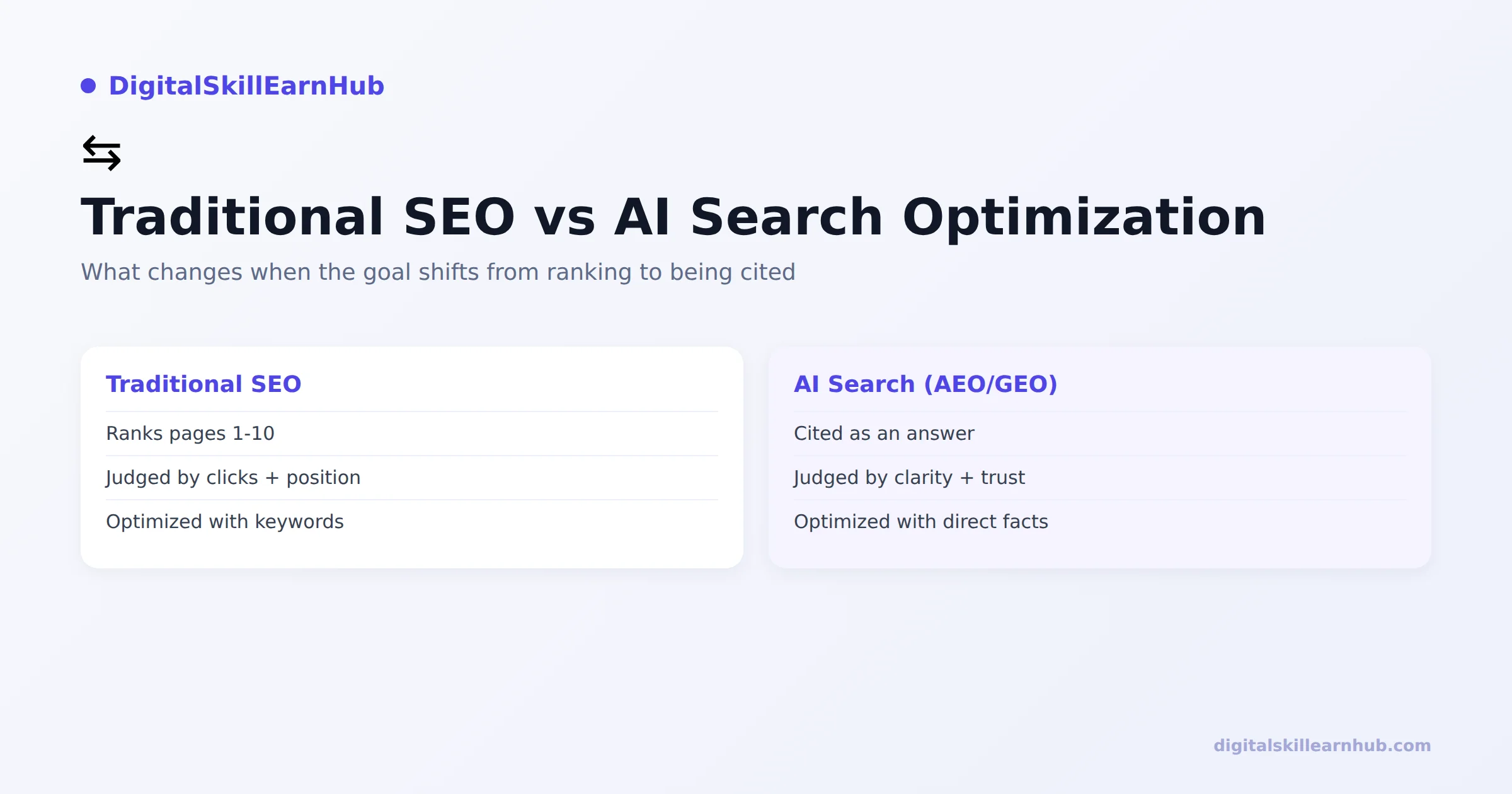
Traditional SEO optimizes for ranking position — being link #1 through #10 on a results page. AI search optimizes for something different: being one of the few sources an AI system chooses to cite or summarize from, regardless of exact rank position.
- Traditional SEO rewards keyword targeting, backlinks, and technical performance
- AI search additionally rewards content that answers clearly, cites specifics, and is easy to extract cleanly
- A page ranking #4 with a precise, well-structured answer can get cited over a page ranking #1 with vague, marketing-heavy copy
This doesn't replace ranking fundamentals — see our SEO audit checklist and technical SEO guide for those. It adds a new layer on top of them.
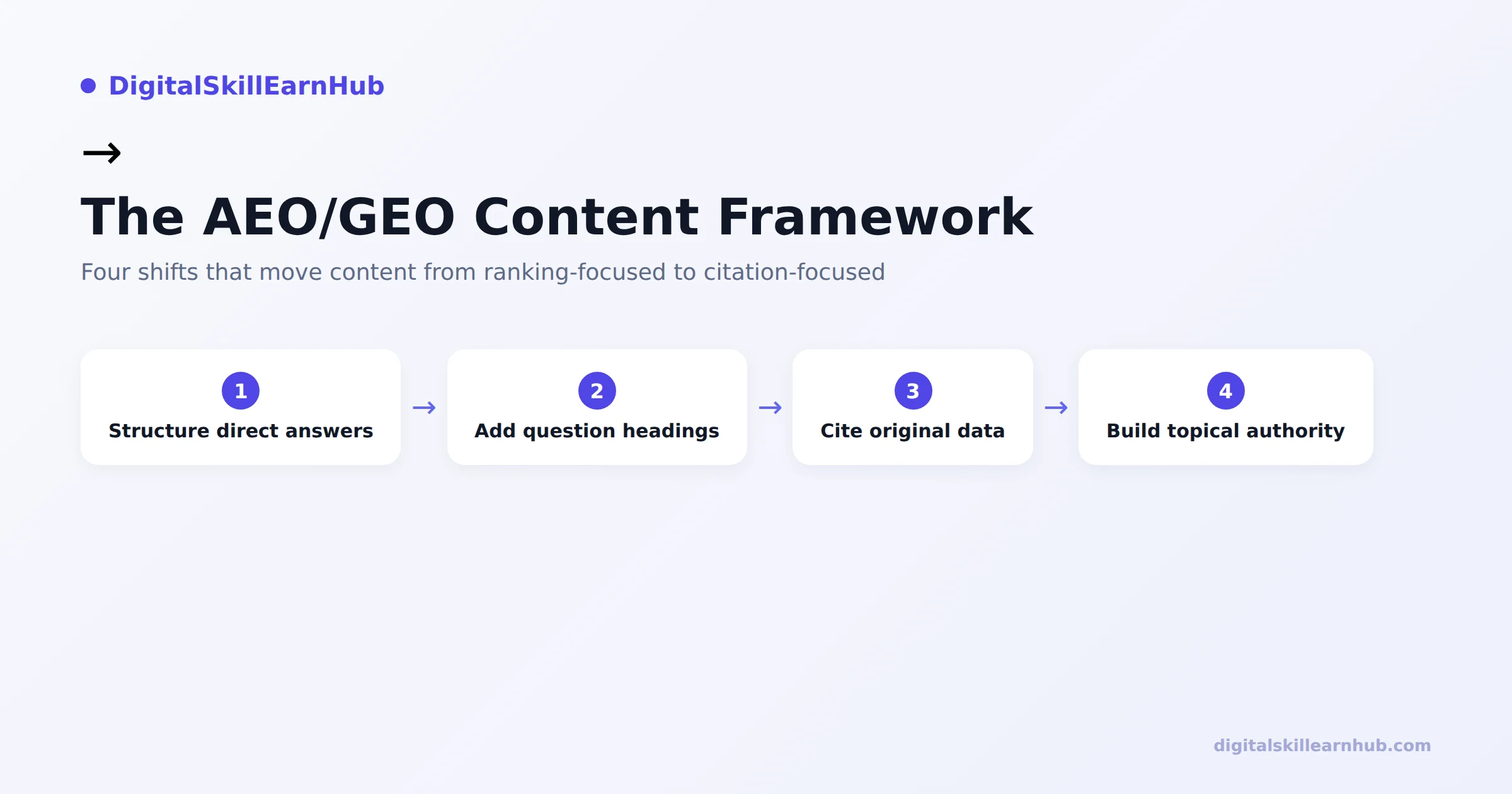
The AEO/GEO Content Framework: 4 Shifts
This is the same structural framework we used to rewrite our own AI-search content — four shifts that move a page from ranking-focused to citation-focused.
1. Structure Direct Answers
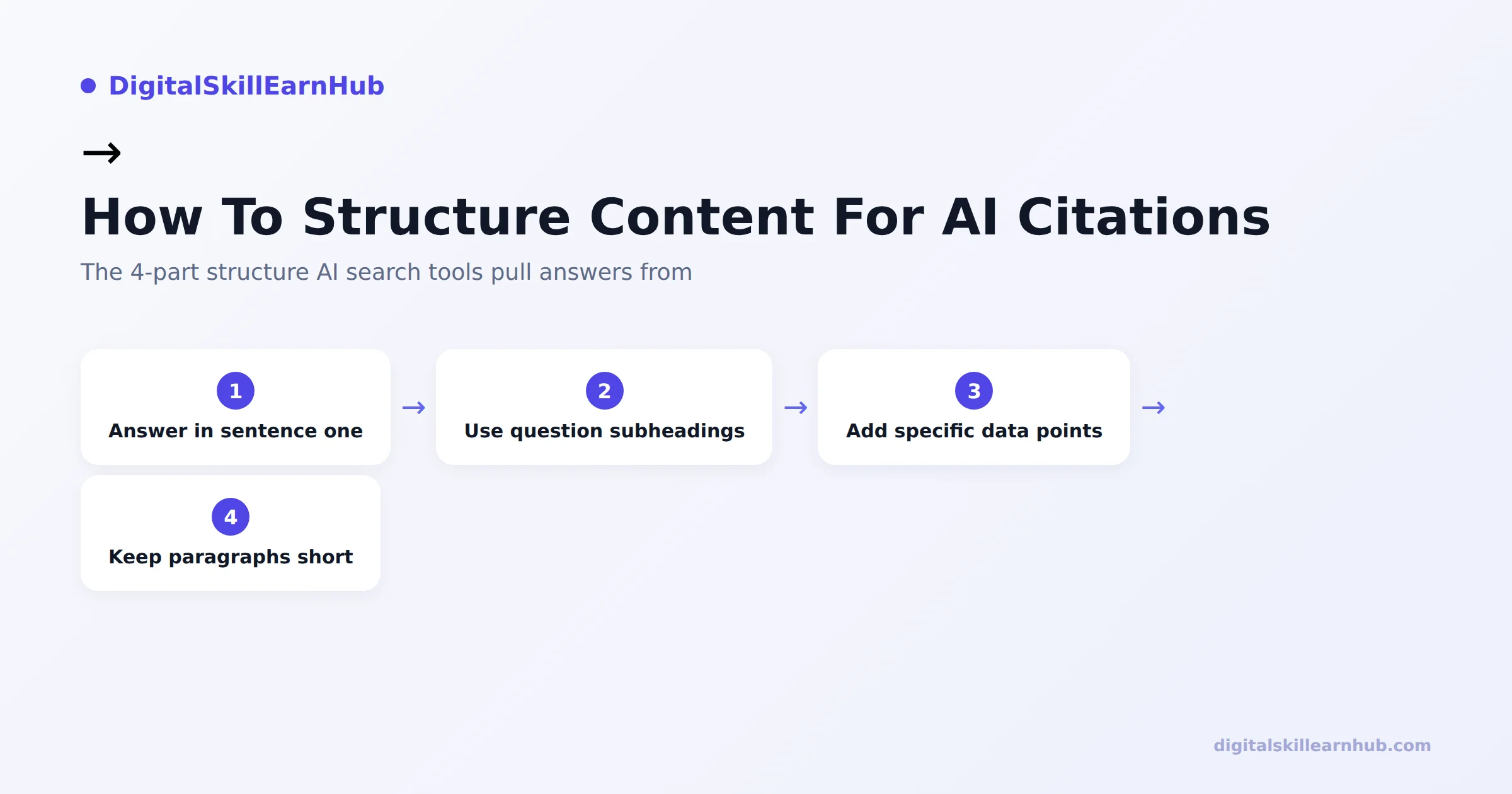
Open each major section with a one-to-two sentence direct answer to the question implied by the heading, before expanding into detail. AI systems extract this opening answer far more reliably than a build-up paragraph that arrives at the point three sentences in.
2. Add Question Headings
Phrase H2/H3 headings as the actual questions people ask — "How do I diagnose AI Overview impact?" instead of "Diagnosis Methods." This matches how both users and AI parsers scan a page for relevant sections.
3. Cite Original Data
Specific numbers, named studies, and concrete examples are harder for an AI system to paraphrase away without losing the substance — which makes them more likely to be preserved and attributed. Generic statements ("many websites see improvements") get flattened into the AI's own wording with no citation. Specific ones ("clicks fell 38% when an AI Overview appeared") tend to survive into the summary, often with attribution.
4. Build Topical Authority
AI systems, like traditional rankings, favor sources that demonstrate depth on a topic rather than a single isolated article. Build a cluster of related, internally-linked content around each core topic — the same principle behind topical authority in traditional SEO, covered further in our indexed but not ranking guide.
What About FAQ Schema? (2026 Update)
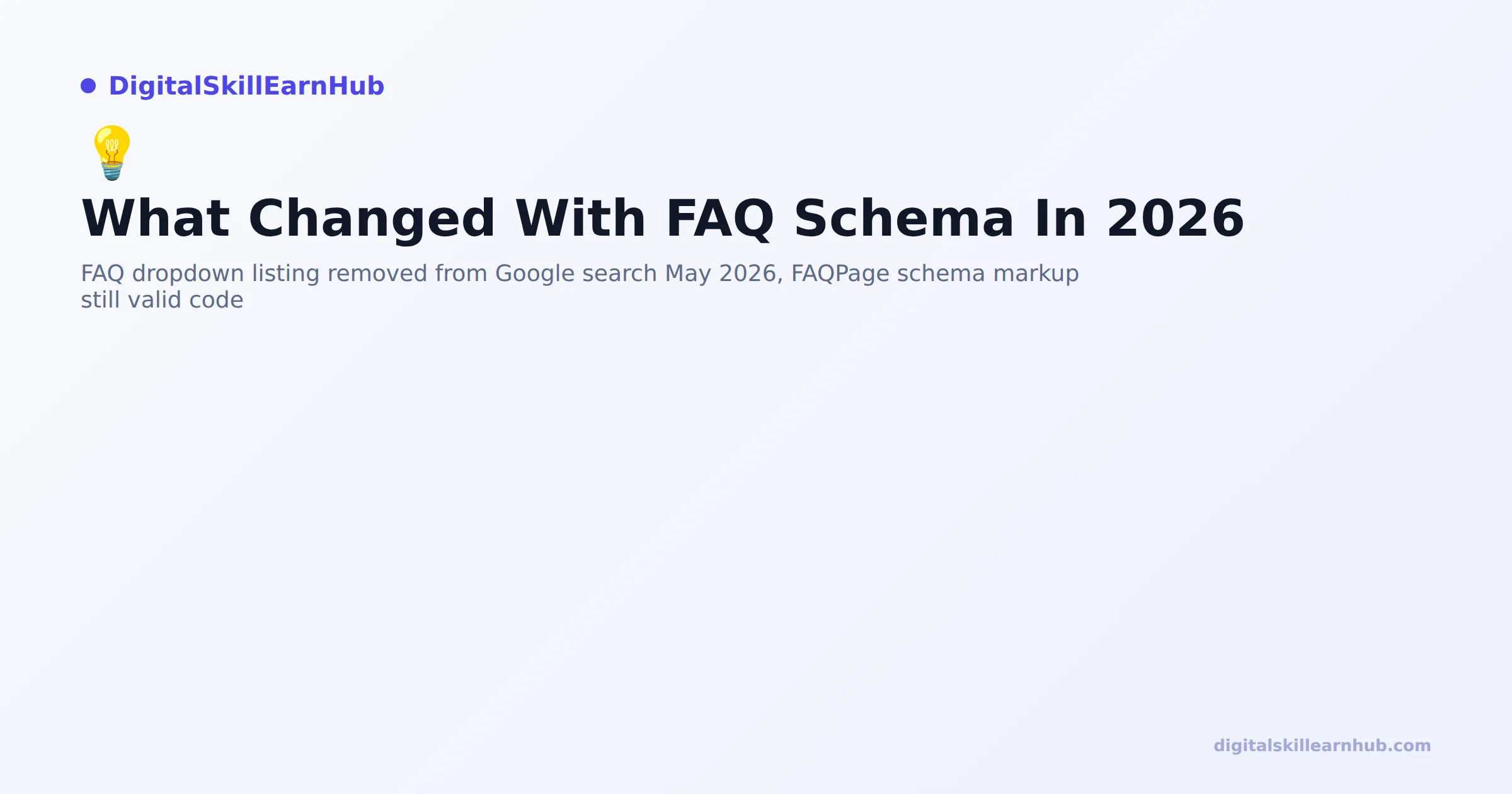
Google removed the visible FAQ rich-result dropdown from search results on May 7, 2026 (previously limited to government and health sites since 2023). Search Console's FAQ reporting tools followed in June 2026, and FAQ API support ends in August 2026.
This has led some site owners to strip FAQPage schema entirely, assuming it's now useless. That's a mistake. The visual rich result is gone, but the structured markup itself is still valid and still read by machines — including the same AI systems this guide is about. A clean set of Question/Answer pairs, marked up properly, is exactly the format AI Overviews, ChatGPT, and Perplexity favor when extracting a direct answer.
The fix: keep FAQPage schema on your pages, but stop treating it as a Google rich-result ranking tactic. Treat it as a way to hand AI systems a clean, citable answer format instead.
Measuring Whether It's Working
AEO/GEO doesn't show up as a single metric in Search Console, so measuring progress takes a combination of signals:
- Impressions vs. clicks divergence. If impressions keep climbing while CTR stabilizes or improves after a rewrite, your content is likely being cited with attribution rather than just summarized.
- Manual AI tool checks. Search your priority questions directly inside ChatGPT and Perplexity, and note whether your domain appears as a cited source. Repeat monthly to track change.
- Google AI Overview appearance. Manually search your target queries and check whether an AI Overview cites your page as a source link.
- Traditional rank tracking still matters as a baseline — a page that stops ranking altogether won't get cited either.
This is a slower feedback loop than traditional rank tracking, so give changes 4-6 weeks before judging results, similar to any other content or technical SEO change covered in our zero-click fix guide.
Final Thoughts: Write to Be Cited, Not Just Ranked
AI Overviews, ChatGPT, and Perplexity aren't going away, and they're pulling an increasing share of clicks away from traditional results. The sites that adapt aren't the ones fighting this shift — they're the ones restructuring content to be the clear, specific, well-organized source these systems choose to cite.
Start with your highest-impression, lowest-CTR pages, apply the four-part framework above, and keep your FAQ schema even though the visual rich result is gone. For the data behind why this matters right now, revisit why your clicks dropped even though impressions are up.
FAQs: AEO/GEO Optimization
What is AEO?
AEO (Answer Engine Optimization) is structuring content to be pulled directly into AI-generated answer boxes like Google AI Overviews, rather than just ranking as a blue link.
What is GEO?
GEO (Generative Engine Optimization) is the broader practice of optimizing content to be cited by generative AI tools such as ChatGPT, Perplexity, and Google AI Overviews.
Is AEO/GEO different from traditional SEO?
It builds on traditional SEO rather than replacing it. Rankings, technical SEO, and authority still matter, but content structure and citability become equally important.
Do I need to rewrite all my old content?
No. Start with pages that already rank but show falling CTR, since those are most likely being summarized by AI Overviews without generating a click.
Does FAQ schema still matter after Google removed the FAQ rich result?
Yes. The visible FAQ dropdown was removed from Google Search in May 2026, but FAQPage schema still helps AI systems parse content into clean question-answer pairs for citation.
How do I know if ChatGPT or Perplexity are citing my site?
Search your target questions directly in ChatGPT and Perplexity and check whether your domain appears as a cited source, then repeat periodically to track change.
Does site authority still matter for AI citations?
Yes. AI systems favor sources that already show topical authority and are frequently cited or linked elsewhere, similar to how traditional rankings work.
What's the fastest first step to improve AEO/GEO?
Rewrite your introduction so the first sentence directly answers the page's main question, then add question-phrased subheadings throughout.
Can small websites compete for AI citations against big brands?
Yes, more easily than in traditional rankings in some cases, because AI systems often reward clear, specific, well-structured answers over sheer domain authority alone.
Should I track AEO/GEO performance differently than SEO?
Track it alongside standard SEO metrics: watch impressions-vs-clicks divergence in Search Console and manually check AI tools for citations on your priority queries.